


ฉลากอัจฉริยะที่บ่งชี้คุณภาพของผลิตภัณฑ์ด้วยการเปลี่ยนแปลงสีจากอุณหภูมิและเวลา
การรักษาคุณภาพผลิตภัณฑ์สดเป็นเรื่องสำคัญ เนื่องจากอุณหภูมิในขณะขนส่งและการจัดเก็บบางครั้งอาจสูงกว่าอุณหภูมิการเก็บรักษาซึ่งทำให้อาหารเสื่อมสภาพเร็วกว่าที่ประเมินไว้ ปัจจุบันมีการพัฒนาเทคโนโลยีบรรจุภัณฑ์อัจฉริยะที่สามารถบอกคุณภาพของสินค้าได้ด้วยการเปลี่ยนสีฉลากบนบรรจุภัณฑ์ โดยอาศัยพอลีไดอะเซทิลีน (PDA) ที่มีคุณสมบัติเปลี่ยนสีตามอุณหภูมิและเวลากับอนุภาคโลหะออกไซด์นาโนเพื่อเพิ่มความไวในการเปลี่ยนแปลงสีของฉลาก
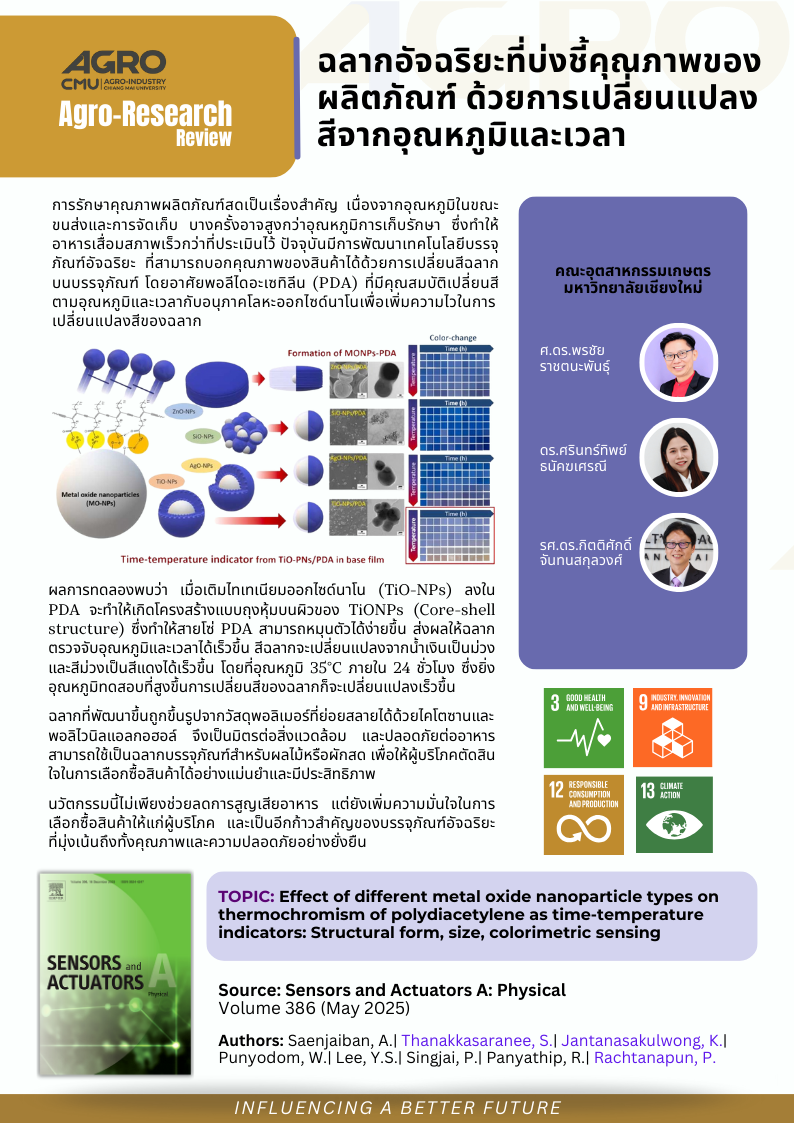
ผลการทดลองพบว่า เมื่อเติมไทเทเนียมออกไซด์นาโน (TiO-NPs) ลงใน PDA จะทำให้เกิดโครงสร้างแบบถุงหุ้มบนผิวของ TiONPs (Core-shell structure) ซึ่งทำให้สายโซ่ PDA สามารถหมุนตัวได้ง่ายขึ้น ส่งผลให้ฉลากตรวจจับอุณหภูมิและเวลาได้เร็วขึ้น สีฉลากจะเปลี่ยนแปลงจากน้ำเงินเป็นม่วงและสีม่วงเป็นสีแดงได้เร็วขึ้น โดยที่อุณหภูมิ 35°C ภายใน 24 ชั่วโมง ซึ่งยิ่งอุณหภูมิทดสอบที่สูงขึ้นการเปลี่ยนสีของฉลากก็จะเปลี่ยนแปลงเร็วขึ้น
ฉลากที่พัฒนาขึ้นถูกขึ้นรูปจากวัสดุพอลิเมอร์ที่ย่อยสลายได้ด้วยไคโตซานและพอลิไวนิลแอลกอฮอล์ จึงเป็นมิตรต่อสิ่งแวดล้อมและปลอดภัยต่ออาหาร สามารถใช้เป็นฉลากบรรจุภัณฑ์สำหรับผลไม้หรือผักสด เพื่อให้ผู้บริโภคตัดสินใจในการเลือกซื้อสินค้าได้อย่างแม่นยำและมีประสิทธิภาพนวัตกรรมนี้ไม่เพียงช่วยลดการสูญเสียอาหาร แต่ยังเพิ่มความมั่นใจในการเลือกซื้อสินค้าให้แก่ผู้บริโภค และเป็นอีกก้าวสำคัญของบรรจุภัณฑ์อัจฉริยะที่มุ่งเน้นถึงทั้งคุณภาพและความปลอดภัยอย่างยั่งยืน
--
Smart label that indicates product quality through temperature- and time-dependent color changes
Maintaining the quality of fresh products is essential, as temperatures during transportation and storage may sometimes exceed recommended levels, which can accelerate food deterioration beyond expected rates. In response to this challenge, intelligent packaging technologies have been developed to indicate product quality through color changes in indicator labels. These technologies utilize polydiacetylene (PDA), which exhibits temperature- and time-dependent chromatic transitions. The PDA was combined with metal oxide nanoparticles (MO-NPs) to enhance the sensitivity of the colorimetric response.
Experimental results revealed that incorporating titanium oxide nanoparticles (TiO-NPs) into the PDA induces the formation of a core–shell structure on the TiO-NPs surface. This structural alignment facilitates greater rotational mobility of PDA chains, thereby accelerating the label’s responsiveness to temperature and time. As a result, the indicator label showed faster color transitions from blue to purple and from purple to red. Notably, the indicator label changed color within 24 h at 35 °C. Higher testing temperatures further increased the rate of chromatic transition.
The developed indicator label is fabricated from biodegradable polymers, namely chitosan and polyvinyl alcohol (PVA), making it environmentally friendly and food-safe. The label can be applied to indicator label for fresh fruits and vegetables, enabling consumers to make informed and accurate purchasing decisions.
This innovation not only helps reduce food loss across the supply chain but also enhances consumer confidence in product freshness. Overall, it represents a significant advancement in intelligent packaging technology, emphasizing sustainable quality and safety.
Topic: Effect of different metal oxide nanoparticle types on thermochromism of polydiacetylene as time-temperature indicators: Structural form, size, colorimetric sensing
Authors: Saenjaiban, A.| Thanakkasaranee, S.| Jantanasakulwong, K.| Punyodom, W.| Lee, Y.S.| Singjai, P.| Panyathip, R.| Rachtanapun, P.
Abstract:
Time-temperature indicators (TTIs) are widely fabricated from color-sensing components with polydiacetylene (PDA) and metal oxide nanoparticles (MO-NPs) film formation as the core-shell structure. The influence of different types of MO-NPs such as zinc (ZnO-NPs), silicon (SiO-NPs), silver (AgO-NPs), and titanium (TiO-NPs) was investigated by color-changing sensors on PDA solutions and chitosan-polyvinyl alcohol (PVA) films. The PDA and chitosan/PVA solutions were formed by adding different MO-NPs, to reveal their diverse properties. The TiO-NPs/PDA film, as the core-shell structure, combined with the carboxylic groups and interacted with PDA. A thin PDA shell was formed on the TiO-NPs that enlarged the surface area and allowed more free rotation of the PDA side chains for TiO-NPs/PDA. As a result, the core-shell structure showed improved sensitivity in color changing (blue to red at 35°C within 96 h), reflected by a higher color response (%CR), corresponding to the shifting of λmax in the absorption. The TiO-NPs/PDA-embedded chitosan/PVA film also showed color sensing improvement (purplish-blue to purplish orange at 35○C within 1 day). Thus, TiO-NPs/PDA-embedded chitosan/PVA films showed potential as TTI devices for tracking product quality and temperature during storage.
Keywords: Core-shell structure; Nanoparticles; Polydiacetylene; Self-assembling; Time-temperature indicator; Titanium oxide
View at publisher: https://www.sciencedirect.com/science/article/pii/S092442472500158X?via%3Dihub
#อกมช. #agrocmu #CMU